What a day at Kjerag costs
Start with the part that is free
There is no gate at Kjerag. No permit, no time slot, no entrance desk, no opening hours, nobody counting you in or out. I sold coffee in the service building at Øygardstøl for eleven summers and I never once took money from anyone for walking up the hill behind me. The mountain is open ground and always has been. The longer version of that answer is on whether the hike is free.
So when somebody at my counter asked what a Kjeragbolten ticket cost, the honest answer was that they were asking about the wrong object. What costs money at Kjerag is arriving at the place where the walking starts. That is the whole story, and the rest of this page is the detail of it.
The car park, which drivers cannot avoid
Parking at the trailhead is paid. It is a large facility by mountain standards, several hundred spaces, and it runs for roughly the same window the road does, somewhere around the middle of May to the end of October. I am not going to print the amount, for the reason I set out above, and also because a stale figure at a barrier is the kind of small betrayal that ruins a morning. The layout and the practical business of arriving are on the car park page, and the question of whether you can simply drive up at all is on the driving page.
The road is the expensive part, whichever way you pay for it
Stavanger to Øygardstøl is roughly two and a half hours each way by road. The full drive round by E39, Rv450 and Sirdal is quoted at about three hours. Either way you are committing five or six hours of the day to being in a vehicle, and however that vehicle is provided, somebody is paying for it. If it is your own car, the cost is fuel and tolls and whatever a rental costs that week. If it is a booked seat, the cost is the seat. There is no third option where the distance quietly goes away.
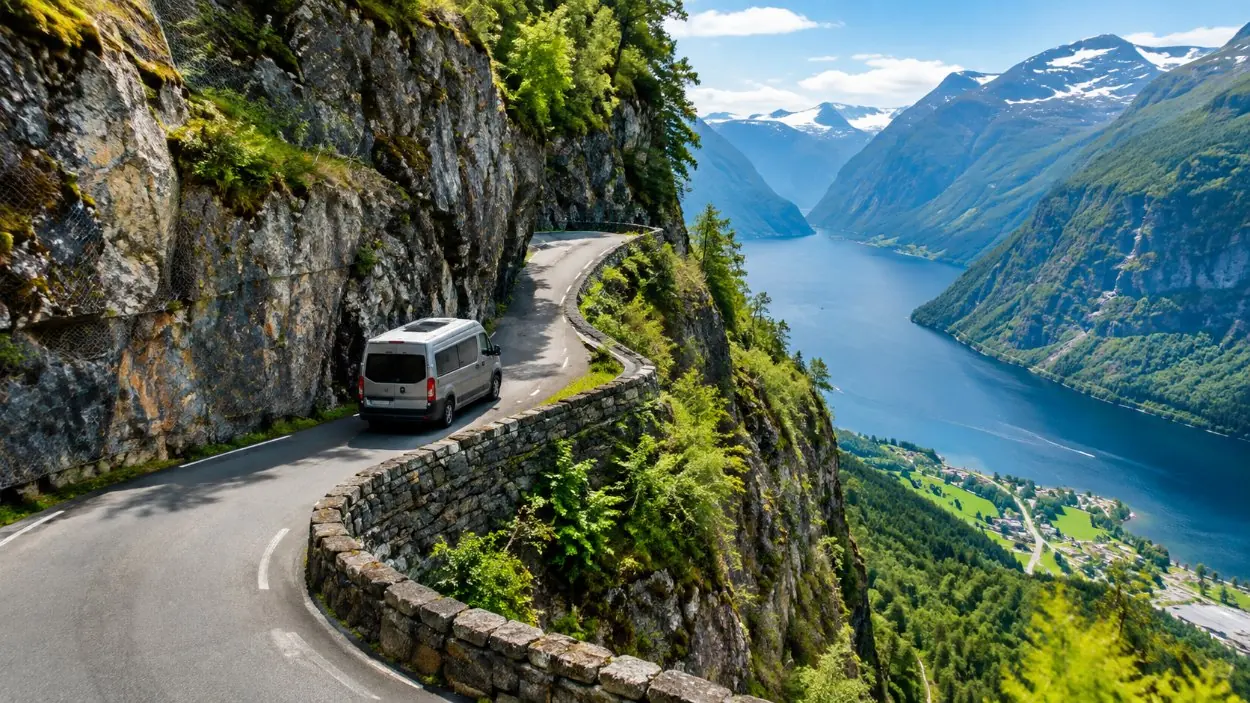
The last stretch is Fv500 and its twenty-seven hairpin bends above Lysebotn. It is narrow, it is a proper mountain pass, and it is shut by snow for most of the year. That closure is the single fact that shapes every other line on this page, because for more than half the calendar there is no cheap version of a Kjerag day: there is a guided winter version or there is nothing. See the road and the hairpins.
The water route, which is a different kind of spending
The other way in is the Lysefjord ferry to Lysebotn. The MS Lysefjord is run by Kolumbus, it leaves from Lauvvik, and it calls at Forsand, Bratteli, Bakken, Sognesand, Kalleli, Flørli and Håheller on the way. Roughly two or three departures a day, varying by day and by season. Lauvvik itself is reachable by bus from Stavanger. That is a ticket, and then a second ticket for the bus, and then the problem that you are standing in Lysebotn at sea level with the trailhead still at the top of the hairpins. Read the getting-there page before you build a day around it.
What happens if you have no car
There is no regular public bus from Stavanger to Lysebotn. Seasonal tourist buses run in peak season and they are worth checking, but they are not a timetable you can lean on. In practice, for most visitors without a vehicle, the reliable answer is a booked tour, and the cost of the day becomes one line item instead of six. That is not me selling you something. It is the arithmetic of a road that only exists in summer. The unflattering full version is on getting there without a car.
A guide, and when it stops being optional
In the open season the trail is marked, well walked and hard to lose in decent visibility. A guide then is company, pace, and somebody who knows what the slabs are doing that week. It is a service, not a requirement, and I will not pretend otherwise. Outside the open season the picture inverts completely: the chains come down with the road, the snow covers the ground you were meant to read, and the hike needs winter equipment and a guide. That is a seasonal change in what is worth paying for. The argument is laid out on whether you need a guide.
The boat instead of the mountain
The Lysefjord cruise out of Stavanger does no hiking at all. It goes up the fjord on an electric catamaran, past Hengjanefossen and the Vagabond's Cave, under Preikestolen, and comes back. Nobody gets onto Kjerag from it. For a certain kind of day, and for a certain kind of knee, it is the right answer rather than the consolation prize: the cruise.
Included
- Walking the trail, in any weather, at any hour
- Standing on the boulder, and the photograph
- The chains on the steep slabs, while they are up
- The view down the Lysefjord, when the cloud allows it
- The toilets and the information desk in season
Not included
- Parking at Øygardstøl
- Fuel, tolls or a rental car
- The Lauvvik ferry, and the bus to reach Lauvvik
- A guide, in any season
- The Lysefjord boat, which is a separate trip
Decide the transport before anything else. It sets the length of your day, it is the part people leave until the last evening, and for more than half the year it is the part that quietly has no answer at all unless something is booked.
Four shapes a Kjerag day takes
Your own car. Fuel, the drive round through Sirdal or the ferry and the hairpins, the car park at the top. The most flexible version, and the only one that lets you leave Stavanger at five in the morning. Set out on getting there.
A seat on a guided van. Transport and guiding in one booking, which is why it is the usual choice for anyone without a car. The flagship day runs about eleven hours door to door with a small group: the guided hike.
A private car and guide. Your group only, hotel pickup, and the parking and entry fees folded in so there is nothing to sort out at the top: the private hike.
Two days instead of one. Preikestolen, a cruise, a night in Lysebotn and Kjerag the next morning, which removes the two and a half hour drive from the front of the hiking day: the two-day trip.
Where the money actually goes
Add an honest Kjerag day up and the trail is nothing, the car park is small, and getting to the top of Fv500 is nearly all of it. That is the one sentence about cost worth remembering, and it is why this site spends more pages on roads than on rucksacks. The comparison between the formats is on which one to choose, and every product is on the bookings page.
Booking the transport
Below is the guided day out of Stavanger, the one with the small group and the hotel pickup.
A word about what that widget books. It books the ride out of Stavanger and, on most of these, a guide. It does not book Kjerag. Nobody sells a ticket to the trail: it is free, open and unguided, and anyone who gets themselves to the top of the road can walk up it without paying a soul.
Frequently asked questions
Do you have to pay to hike Kjeragbolten?
No. The trail is free, open and unguided, with no ticket, no permit and no gate: the free-hike page.
Is there an entrance fee at the trailhead?
There is no entrance to pay for. There is a parking fee if you arrive by car, at a car park that runs roughly mid-May to the end of October: how parking works.
Why does this page print no figures?
Because they change, and a wrong number at a barrier or a ferry desk is worse than none. The structure of the spending does not change, so that is what I describe here.
What is the biggest expense of a Kjerag day?
Getting to the top of the road, in almost every case. The routes are compared on the getting-there page and on the no-car page.