Has Anyone Fallen Off Kjeragbolten?
Why almost everyone believes the opposite
Because of BASE jumping. Kjerag is one of the best known BASE jumping cliffs in the world, jumpers have been killed there, and accidents are reported most years. Those deaths are real and they are reported as happening at Kjerag, which is true. They are not hikers. A BASE jumper is doing a different sport, from a different part of the cliff, with a parachute, on purpose. When you search for Kjerag and read a number, that number almost always belongs to them.
I watched this confusion arrive at the counter for eleven summers. Someone would come in holding a phone, ask me how many people the boulder had killed, and be genuinely relieved when I said none. The two activities share a mountain and nothing else. I have written the separation out properly on the BASE jumping page and given the fatality question its own answer on how many have died.
Where people actually get hurt
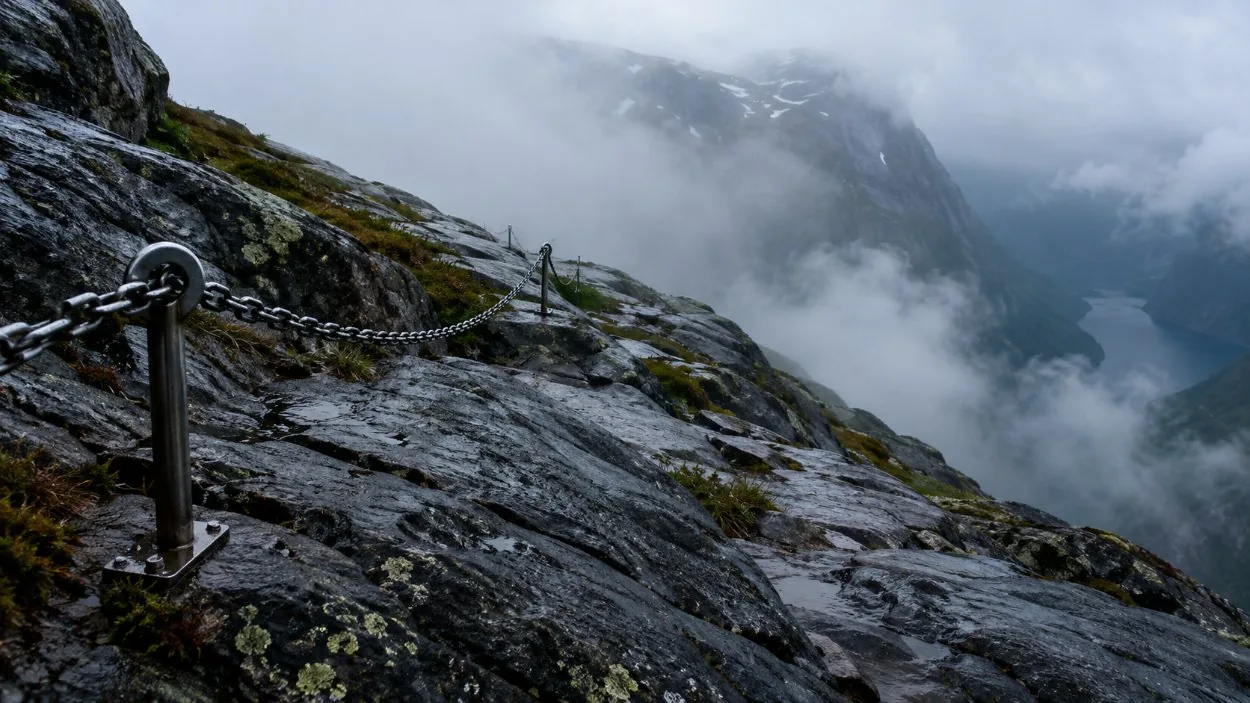
On the ground, between the car park and the plateau. The round trip is about 11 kilometres with something like 760 to 800 metres of climbing, and that climbing is not in one line: you go up, drop into Litle Stordal, go up again, drop again, and go up a third time. On the way back you do all of it in reverse with tired legs. That is where the turned ankles and the broken bones come from — bad landings on wet rock, a slip on a slab, a foot put down without looking at hour seven.
There is no published count of hiker injuries here, so I am not going to give you one. What I can tell you is what the pattern looked like from the service building: almost never the boulder, almost always the descent, and almost always someone who set off late and was walking in the last of the light. The rock is slippery when it is wet, which is exactly why there are several hundred metres of chains bolted along the steep sections.
What the step onto the boulder is actually like
It is a short stride, sideways, onto a flat top, with rock on both sides of the crevice. You do not climb, you do not jump, and nobody hands you a harness because none is needed. The drop underneath is 984 metres and your body knows it, which is a different problem and an honest one — that is covered on whether it is scary.
None of this means Kjerag is safe in the way a pavement is safe. It is an unfenced mountain with a long way down on one side. It means the danger is not where people point it.
If you are worried about the boulder, go and look at it first and decide afterwards. Plenty of people walk out, watch the queue for ten minutes, take the photograph from the side and go home perfectly satisfied. Nobody at Kjerag is counting who stepped on.
What there is to book
Not the trail. Nobody sells a ticket to Kjerag and nobody could, because there is no gate and nobody standing at one. What you pay for is the ride out of Stavanger and the guide who walks it with you, and the road up is open for about five months a year. The options are laid out on the bookings page and compared on the decision page.
Frequently asked questions
Has anybody ever died on Kjeragbolten itself?
There is no recorded death from falling off the boulder in Norwegian history. The fatalities associated with Kjerag belong to BASE jumping, which is a separate activity.
So why do the search results look so grim?
Because they mix the two. Jumpers have been killed at Kjerag and accidents are reported most years, and those reports say Kjerag without saying BASE jumping.
Do hikers get injured at Kjerag?
Yes, on the trail. Falls on wet rock, turned ankles and bad landings, mostly on the way down. No figures are published for them. See how safe it is.