Is Kjerag worth it?
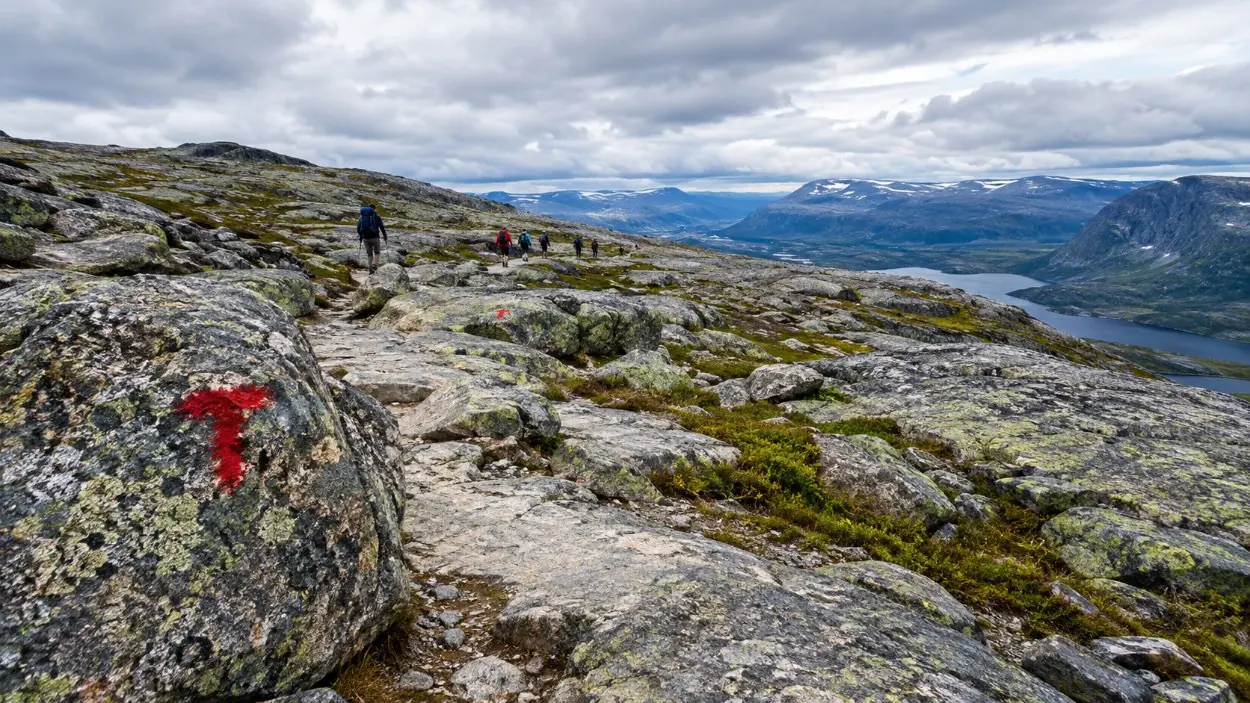
Why I still say yes
Because the ground is extraordinary and almost nobody photographs it. The Kjerag plateau is bare, scoured, pale rock running out towards an edge that drops the better part of a kilometre into the Lysefjord. You walk across it with the whole fjord open on your right and the light doing whatever the light is doing that hour. The boulder is the thing people come for, and it is a good thing, but the reason to spend a day on this mountain is the last hour of walking before you reach it.
And then there is the stride itself. Kjeragbolten is about five cubic metres of rock wedged in a crevice with the fjord 984 metres below, left there by the ice around fifty thousand years ago and jammed tight when the land rebounded faster than the sea could rise. You step onto it from the side. It is a half-metre stride onto a flat top with rock walls on both sides of the gap. No equipment, none provided, none needed. People build it up into an act of nerve and then find it is a step. That is covered properly on the boulder page.
Who should not do this
Anyone who wanted a viewpoint with a car park at the top. The car park is at the bottom. Between it and the boulder there are three ascents and two descents and something in the region of eight hundred metres of climbing, accumulated the hard way. If that is not the day you pictured, read how hard it is before you book a thing.
Anyone with bad knees or a bad ankle. The descent is where this trail collects people. You come down the same three climbs on legs that have already done the whole day, on rock that is polished in places and wet in others. I watched the evening arrivals for eleven summers and the limping was always on the way in, never on the way out.
Anyone short of daylight. Six to ten hours on the trail plus five hours of road is not a half day and cannot be made into one. The arithmetic is on how long it takes and the start-time rule is on the best time of day.
Anyone visiting outside the open season. Fv500 is shut by snow for most of the year, the chains come down with it, and what remains is a winter mountaineering day. Read the season page before you book flights around this.
Anyone off a cruise ship with a normal port call. An eleven-hour Kjerag day does not fit inside a day in port, and I would rather tell you that here than have you miss the ship: the cruise-ship arithmetic.
What works
- A plateau that feels like the top of the world and is usually half empty
- Free, unticketed, unfenced and open at any hour the road is
- The stride onto the boulder is genuinely easy, which surprises everyone
- Chains on the steep slabs, so the hard sections have something to hold
- Small guided groups out of Stavanger solve the road and the timing at once
Worth knowing
- Eleven kilometres and up to ten hours, which the photographs never show
- Three climbs and two descents, so you gain the same height more than once
- Fog sits on the plateau while the car park below is in sunshine
- The road is open roughly five months a year and shut the rest
- There is a queue for the boulder photograph on an August afternoon
The comparison people actually want
If the question behind your question is which Norwegian rock to walk to, the honest ranking is about effort, not beauty. Preikestolen is a flat plateau 604 metres above the same fjord, about eight kilometres round trip, four to five hours, no chains, and an hour from Stavanger rather than two and a half. It is the easier day by a wide margin and it is not a lesser one: Kjerag or Preikestolen. Trolltunga is in Odda, a different region several hours away, and it is roughly two and a half times the length of Kjerag. Kjerag is the steeper one per kilometre; Trolltunga is the longer one: Kjerag or Trolltunga.
The fear question, since it is usually hiding in this one
People ask whether Kjerag is worth it when what they mean is whether it is safe. So, plainly: there is no recorded death from falling off Kjeragbolten in Norwegian history, across decades and tens of thousands of visitors a year. The deaths associated with this cliff belong to BASE jumping, which is a different sport practised by different people off the same wall. The injuries belong to the trail, where wet rock and tired legs do what wet rock and tired legs do. Those three things get separated properly on the safety page.
If you are unsure whether the day is for you, be honest about the descent rather than the climb. Anyone who can walk uphill for three hours can usually get to the boulder. Getting back to the car park is the part that decides whether the day was a good one.
The version of this day that is worth paying for
For most visitors the sensible shape is somebody else driving. Five hours behind a wheel on either side of a ten-hour walk is where the real risk of the day sits, and a seat in a small van removes it. The flagship runs out of Stavanger with hotel pickup and a group of no more than eight: the guided hike. If you would rather not hike at all and still see the Lysefjord, the boat is on the cruise page.
A word about what that widget books. It books the ride out of Stavanger and, on most of these, a guide. It does not book Kjerag. Nobody sells a ticket to the trail: it is free, open and unguided, and anyone who gets themselves to the top of the road can walk up it without paying a soul.
Frequently asked questions
Is Kjeragbolten worth the hike?
Yes, if you want a long day on bare rock above a fjord. No, if you want a viewpoint with a short walk: how hard it is explains the difference.
Is Kjerag better than Preikestolen?
Different, not better. Preikestolen is about 8 km, 4 to 5 hours and an hour from Stavanger; Kjerag is 11 km, 6 to 10 hours and two and a half: the comparison.
Do you have to step on the boulder?
No. Plenty of people walk out, look at it and walk back, and the plateau is worth the day on its own: on whether it is scary.
Is it worth booking a tour rather than driving?
For most people without a car, yes, because there is no regular bus to Lysebotn: the no-car page.