How hard is the Kjerag hike?
Why three climbs is the whole answer
People read eight hundred metres of ascent and picture a single slope. Kjerag is not built that way. You climb hard out of the car park, drop into a dip, climb again, drop again into Litle Stordal, and climb a third time onto the plateau. Then you walk out to the boulder, turn round, and do every one of those in reverse. The height you gained is given back and taken again five times across the day, and that is why the time estimate runs as wide as six to ten hours. It is not that some people are four hours fitter than others. It is that the profile punishes anyone who has spent their legs early. The stage-by-stage walk-through is on the trail page.
What the surface is actually doing
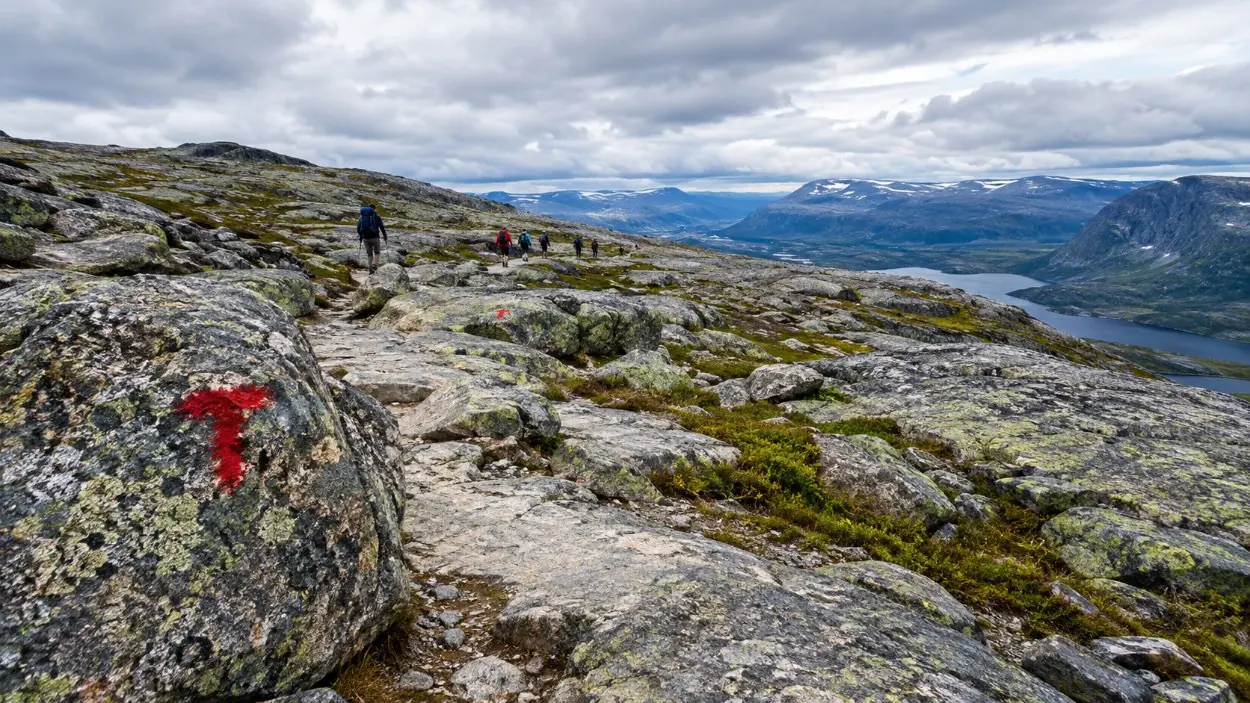
Most of what you walk on is bare rock. Not a path cut into a hillside, not gravel, not steps that somebody built. Slab. In the dry it is grippy and pleasant. Wet, it is a different material altogether, and Kjerag is in a part of Norway where wet is the default assumption rather than the exception. The chains exist because of this. There are several hundred metres of them bolted along the steepest sections, and they are there to be used, not admired. Detail on the chains page.
The chains come down when the road closes for winter and go back up when it opens. That matters more than it sounds. Outside the open season you are not doing a harder version of the same walk, you are doing a different walk without the handholds, and that walk needs winter equipment and a guide.
The descent is the part that hurts people
I watched eleven summers of people come back down to the car park and I can tell you where the trouble sits. Nobody turns an ankle at ten in the morning on the first climb. They turn it at four in the afternoon on the third descent, with legs that have nothing left, on a slab that has gone greasy under a light drizzle nobody bothered to put a jacket on for. Going down steep wet rock is a skill and it is the skill most visitors have least of. Plan your day so you reach the descent with something in reserve, which mostly means starting early: the best time of day.
What works
- No scrambling, no exposure problem, no equipment to learn
- The chains give you something solid on every steep section
- The route is well walked and easy to follow in decent visibility
- Fit walkers genuinely do it in around six hours
- The plateau at the top is flat and easy walking
Worth knowing
- Eight hundred metres of climbing spread over three separate ascents
- Bare rock that becomes slippery the moment it is wet
- The descent is longer and harder than anyone expects
- Fog can arrive on the plateau with no warning from below
- Six to ten hours on top of five hours of road makes a very long day
How fit do you need to be?
The useful test is not a gym number. It is whether you have done a full day of hillwalking in the last year and enjoyed the second half of it. If you have walked six or seven hours over rough ground before, Kjerag is within reach and you will have a good day. If your recent walking has been an hour at a time on flat ground, this is a big jump and the mountain will find it out at about hour six. Nobody at the top will care, but your knees will.
Age is not the measure either. I have seen people well into their seventies come back down looking better than the twenty-five-year-olds who went up in trainers. What separated them was pace, footwear and honesty about turning round.
What makes it harder than the numbers suggest
Three things, and none of them are on the signpost. Wind comes up the fjord side and hits you on the open sections where you would rather be steady. Fog sits on the plateau while the car park is in sunshine, so your view of the route disappears at exactly the height where the ground gets featureless. And wet slab changes the whole character of the descent. Visit Norway's own advice is to turn back for strong wind, heavy rain or fog, and I would underline all three. More on weather and rain.
What makes it easier
Boots with ankle support and a sole that grips wet rock. Poles, if your knees are the weak part, because they do most of their work on the way down. Starting early enough that a slow day is still a daylight day. Eating before you are hungry. And a guide, if you want somebody who has seen the conditions all week rather than a forecast: on guides.
Turning round at the first chain is not a failure, it is a decision, and it is the right one for a fair number of people every summer. The mountain does not get easier further in, and the way back gets longer with every step forward.
Compared with the neighbours
Preikestolen is the easier day by a clear margin: about eight kilometres, four to five hours, no chains, and far more people on it. Trolltunga is the longer day, roughly two and a half times the length of Kjerag, in a different region entirely. Kjerag sits in between in hours and above both in steepness per kilometre. If the Kjerag numbers on this page have made you hesitate, the honest alternative is the Preikestolen hike rather than a smaller version of this one, because there is no smaller version of this one.
Booking the day so the walk is the only hard part
The guided day out of Stavanger covers the two and a half hours of road each way, a safety briefing at the start, and around five and a half hours on the mountain with a group of no more than eight.
A word about what that widget books. It books the ride out of Stavanger and, on most of these, a guide. It does not book Kjerag. Nobody sells a ticket to the trail: it is free, open and unguided, and anyone who gets themselves to the top of the road can walk up it without paying a soul.
Frequently asked questions
Is the Kjerag hike difficult for beginners?
It is a demanding full day rather than a beginner walk. If you have not done six hours over rough ground before, look at the Preikestolen hike first.
Is Kjeragbolten dangerous to step onto?
The stride itself is short and taken from the side, and there is no recorded death from falling off the boulder: the safety page.
Do you need climbing experience?
No. There is no technical climbing and no equipment to learn. There are several hundred metres of chains on the steep slabs: the chains page.
What is the hardest part of the hike?
The final descent, on tired legs and often on wet rock. Read the stage-by-stage trail page for what is coming.
Is Kjerag harder than Trolltunga?
Steeper per kilometre, but much shorter. Trolltunga is roughly two and a half times the length: the comparison.