How safe is Kjerag?
One: the boulder
There is no recorded death from falling off Kjeragbolten in Norwegian history. Not one, across decades, with tens of thousands of people visiting every year. One widely-cited safety write-up went further and recorded neither a fatality nor an accident at the boulder as of the middle of 2023. I treat that as meaning no recorded death from the boulder itself rather than as a guarantee, because a guarantee is not a thing any mountain can offer. But the number is what it is, and it is zero.
Understand what the stride actually involves, because the photographs are designed to hide it. Kjeragbolten is about five cubic metres of rock jammed in a crevice. You do not jump to it, climb onto it or lower yourself down. You step across from the side, roughly half a metre, onto a flat top, with rock walls rising on both sides of the gap. The drop is beneath the boulder, not beneath your step. That is why the photograph looks the way it does and why the act feels so much smaller than it looks. More on the object itself is on the boulder page, the record is on has anyone fallen off, and the question of nerve rather than risk is on is it scary.
What is true is that there is no fence, no railing and no barrier anywhere near it, and none is coming. The plateau is left as it is. That is a real thing to weigh if you are bringing children or if you know you are unhappy near an edge: the no-fence page.
Two: the trail, which is the part that actually hurts people
This is where the real hazard of a Kjerag day sits, and it is unglamorous. Falls happen on the trail away from the boulder: broken bones, turned ankles, bad landings on wet rock. There is no published number for how many and I am not going to invent one. What I can tell you is what eleven summers of watching the car park looked like, and the pattern never varied.
It is almost always the descent. Three climbs on the way out means three descents on the way back, taken on legs that have already done the whole day. The trouble arrives in the afternoon, not the morning.
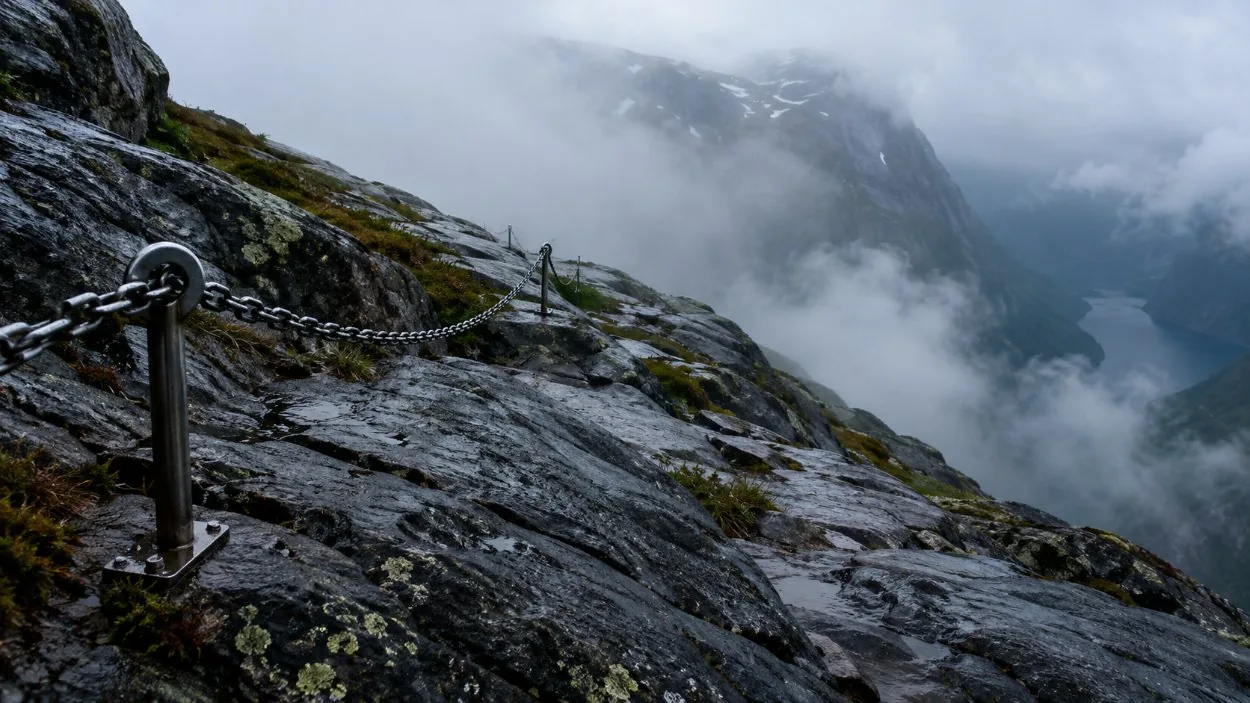
It is almost always wet rock. The trail is bare slab and the slab changes character completely when it is damp. The several hundred metres of chains bolted along the steepest sections exist precisely because of this. Use them.
It is often a late start. Six to ten hours on the trail, plus about two and a half hours of road at each end, fills the entire day. People who set off in the afternoon meet the hardest descent in failing light with nothing in reserve. That is the mechanism behind most of the evenings I remember badly: the start-time page.
And sometimes it is the weather arriving from above. Fog settles on the plateau while the car park below sits in sunshine, and wind comes up the fjord side onto the exposed sections. Visit Norway's own advice is to turn back for strong wind, heavy rain or fog, and that advice is worth taking literally: weather and rain.
Three: BASE jumping, which is not your hike
Kjerag is one of the best-known BASE jumping cliffs in the world. Jumpers have been killed there and accidents are reported most years. If you search for deaths at Kjerag, this is what you will find, and almost none of it has anything to do with walking to a boulder.
BASE jumping from this cliff is a different activity, done by a different set of people, using equipment and taking a risk that has nothing in common with a hiker's day. The fatality figures that circulate about Kjerag belong to that sport. Conflating the two is the most common error in everything written about this mountain, and it has frightened a great many people out of a walk that has never killed anybody from its famous rock. I am not minimising what happens to jumpers. I am saying it is a separate account: the BASE jumping page and how many have died.
The cliff is also used by rock climbers, because it is a big wall. That is a third separate activity, and it is not yours either.
What works
- No recorded death from falling off the boulder, across decades
- The stride onto it is short, sideways, and needs no equipment
- Several hundred metres of chains on the steepest slabs
- A marked route that is easy to follow in decent visibility
- A staffed information desk at the trailhead in season
- Guided groups run small, with a safety briefing before you start
Worth knowing
- Real injuries do happen on the trail: broken bones and turned ankles
- Wet slab is the common factor in most of them
- The descent is where tired legs meet the hardest ground
- No fence, railing or barrier anywhere on the plateau
- Fog can cover the plateau while the car park is in sunshine
- Outside the road season the chains are removed entirely
The things that actually make you safer
None of them are dramatic. Start early enough that a slow day still finishes in daylight. Wear boots that grip wet rock, which is most of what you will walk on: what to wear. Use the chains rather than treating them as decoration. Eat before you are empty, because tired judgement on a descent is the whole problem in one phrase. Agree a turnaround time at the car park and keep it. And turn back for wind, heavy rain or fog without negotiating with yourself about the distance you have already come.
If something does go wrong, the emergency number in Norway is 113, and mountain rescue is reached the same way. Do not assume a phone signal. Assume you may have to send somebody down.
Who should think twice
Anyone whose knees or ankles are already a known weakness, because the descent will find them. Anyone who cannot be certain of finishing in daylight. Anyone who is genuinely unhappy near an unfenced edge, since the plateau does not accommodate that anywhere. And anyone bringing young children, which has a page of its own: with children.
Outside the season it is a different mountain
When Fv500 closes for the winter, the chains come down with it. What is left is not a snowier version of the same walk. It requires winter equipment and a guide, and the sensible framing is mountaineering rather than hiking. The season is on the season page and the road is on the road page.
If you take one thing from this page, take this: the frightening thing at Kjerag is not the boulder, and the dangerous thing is not the boulder either. It is a wet slab at four in the afternoon with nothing left in your legs. Plan the day around that and the rest takes care of itself.
Where a guide genuinely helps
Not by making the boulder safe, because the boulder has never needed it. A guide helps with the things this page has spent its length on: the start time, the pace, the judgement about whether today is a turn-back day, and the two and a half hours of driving at each end that nobody counts as part of the risk and should. Groups are small and the day begins with a briefing. Whether you need one is argued properly on the guide page.
A word about what that widget books. It books the ride out of Stavanger and, on most of these, a guide. It does not book Kjerag. Nobody sells a ticket to the trail: it is free, open and unguided, and anyone who gets themselves to the top of the road can walk up it without paying a soul.
Frequently asked questions
Has anyone died falling off Kjeragbolten?
There is no recorded death from falling off the boulder in Norwegian history: the full record.
Why do people say Kjerag is deadly?
Because the fatality figures online belong to BASE jumping from the same cliff, not to hiking: the BASE jumping page and how many have died.
Where do hikers actually get hurt?
On the trail, usually on the descent and usually on wet rock. The chains are there for exactly those sections: the chains page.
Is there a fence or railing at the boulder?
No, and there is not one anywhere on the plateau: the no-fence page.
What number do you call in an emergency in Norway?
113 for medical help, and mountain rescue is reached the same way. Do not assume you will have a phone signal on the plateau.